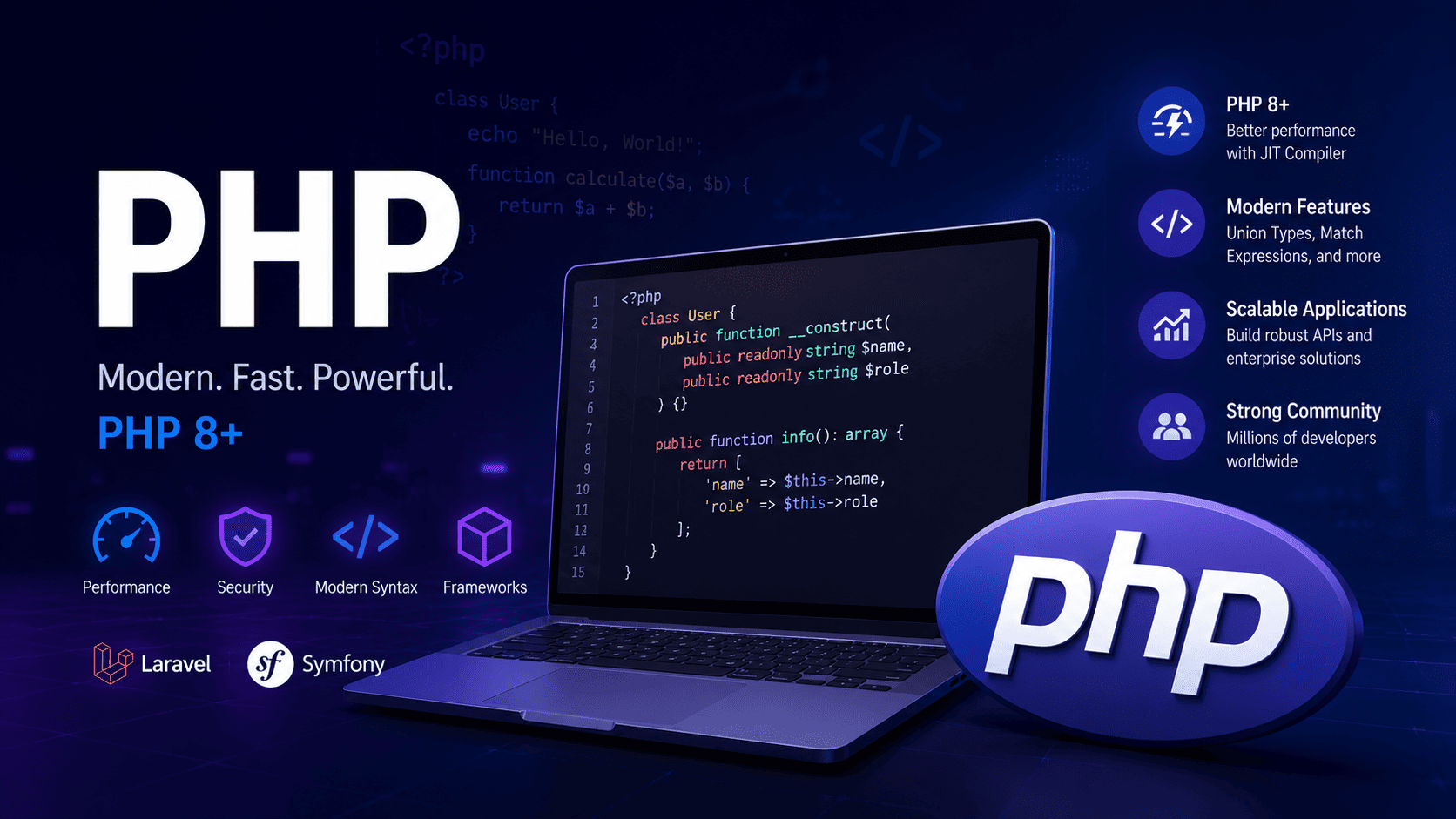
PHP remains a major server-side platform because it combines straightforward hosting, a large ecosystem, mature frameworks, and continuous language improvement. Modern PHP development looks very different from the unstructured scripts that shaped some of its older reputation.
A more expressive language
PHP 8 introduced features such as union types, attributes, named arguments, match expressions, and constructor property promotion. Used with strict types and static analysis, these features help teams express intent clearly and catch defects earlier.
- Typed properties and return values make contracts visible.
- Enums model closed sets of meaningful values.
- Attributes attach structured metadata without fragile comments.
- Modern error handling makes failures easier to observe and diagnose.
Laravel and Symfony
Laravel provides an approachable, integrated development experience for routing, persistence, queues, caching, templates, and common application workflows. Symfony offers a component-oriented foundation that is widely used for long-lived and highly customized systems. The choice should be based on team experience, product lifetime, integration needs, and architectural constraints.
Performance
Current PHP runtimes, OPcache, optimized autoloading, and suitable application caches can serve demanding workloads efficiently. Framework configuration, database access, external services, and avoidable network calls usually matter more than language benchmarks.
API development
Framework routing makes a small JSON endpoint concise:
Route::get('/users', function () {
    return response()->json([
        'name' => 'John Doe',
        'role' => 'Developer'
    ]);
});
Production APIs also need authentication, authorization, validation, pagination, consistent errors, rate limiting, observability, and a versioning strategy. The short route is only the public edge of a larger application design.
Database access
Object-relational mappers such as Eloquent and Doctrine improve productivity, but developers still need to understand generated queries, indexes, transactions, and data integrity. Parameterized queries protect values from SQL injection; they do not replace authorization or sound schema design.
Security practices
- Run a supported PHP version and keep Composer dependencies updated.
- Validate input and escape output for its final HTML, URL, or JavaScript context.
- Use established password-hashing and session-management APIs.
- Store secrets in the deployment environment rather than the repository.
- Disable detailed production error pages while retaining structured server logs.
Why PHP continues to matter
PHP offers low deployment friction, a broad hiring market, strong content-management platforms, and capable frameworks for custom products. It is a practical choice when those strengths align with the application's needs and the team follows modern engineering practices.
Conclusion
Modern PHP is a mature backend platform, not a legacy compromise. Clear architecture, automated testing, secure defaults, and operational discipline determine success far more than the age of the language.